An astrological hypothesis

Twelve bodies, twelve signs, twelve houses
*one architecture*

A reading of the Zodiac anchored, as far as possible, in geometry, mathematics and physics - where every relation inside the circle obeys the submultiples of twelve. Two trans-Plutonian bodies - Haumea and Eris — close the series of twelve celestial bodies

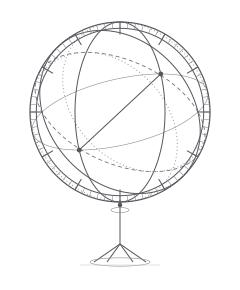
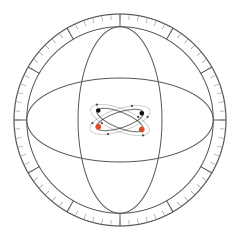
An armillary sphere — the celestial circles rendered as an instrument

How to read this project

Two natures, one circle

I

The theory

Twelve planets, twelve signs, twelve houses

One number governs everything: twelve. The relations inside the zodiacal circle obey only its submultiples — 2, 3, 4, 6. From Ptolemy we keep the anchoring to the seasons; from the modern masters, the planets beyond Saturn.

To complete the scheme we add Haumea and Eris, the two trans-Plutonian bodies — and a new element: the numbering of the planets, from 1-Sun to 12-Moon.

II

The practice

Your birth chart, read by an AI.

An experiment: an artificial intelligence trained only on this project’s own interpretations of the zodiacal circle — not on what it finds elsewhere on the web or in books. You fill in a form; the natal map and its reading arrive by email, as a PDF.

In this first phase nothing is paid. We ask only for feedback — where the portrait rings true, and where it fails.

What we propose

An old circle, read with new eyes.

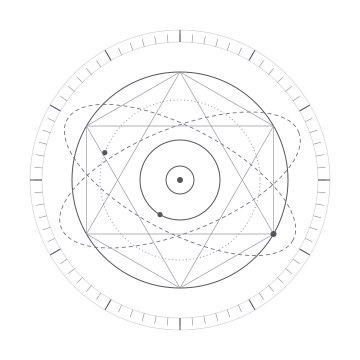
The structure points further than the chart. Two luminaries and two counter-luminaries — Sun and Moon, Saturn and Uranus — suggest that our solar system may descend from a multiple-star system that has since decayed into smaller bodies.

We see an echo of it in Nu Scorpii, the quadruple star the Arabs called Jabbah — “the forehead of the Scorpion.” It gives this project its name, and its working hypothesis.

Read a planet in full: Haumea
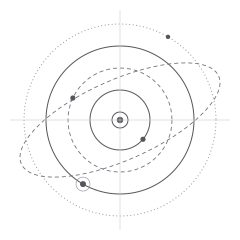
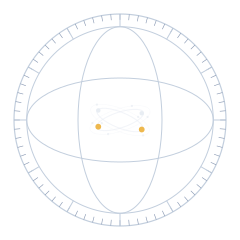
An armillary sphere enclosing a binary system of orbits
The supreme ruler in heaven, Zeus, guiding his winged chariot, advances first, ordering everything and taking care of all — followed by the army of gods divided into eleven squadrons; for Hestia alone remains in the divine mansion, while the others, part of the twelve greater gods, proceed each at the head of a squadron.

— Plato, Phaedrus, XXVI

Yet another astrological hypothesis

A circle divided into twelve thirty-degree sections, with planets assigned to domiciles, exaltations and falls, offers endless room for invention: solar returns, lunar nodes, the Black Moon, degrees attributed one by one — hypothesis upon hypothesis, each with its own valid logic.

Here we choose a narrower path. We follow physical data as closely as we can, guided by the strictest rigour we can manage. Whether we succeed is for the reader to judge — but we do not claim to replace any other tradition. In the vast world, there is room for everyone.

We are drawn to the mythological readings of the Zodiac, and to the psychoanalytic ones; but we lack the competence to follow those roads, and they seem, besides, already well travelled. When needed, we will limit ourselves to a citation.

What we do pursue is the link between signs, planets and houses and concrete phenomena: the seasons of the year and of a life, the geological ages of the Earth, the distances of the planets, orbital cycles, biology. Even in a matter as seemingly irrational as astrology, we try to stay anchored to facts.
Why the name 'jabbah project'

The name has nothing to do with the amiable villain of Star Wars — though we are rather fond of the consonance. We chose Jabbah after the multiple-star system Nu Scorpii, in the constellation Scorpio: the Arabic name of its brightest star means “the forehead of the Scorpion.”

Astronomy tells us such systems are rare, and unstable — they tend to decay into smaller ones. The zodiacal structure, with its two luminaries and two counter-luminaries, seems to remember a system of just this kind. (see Wikipedia, NASA and Glyphweb)