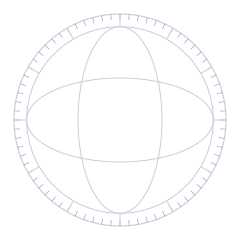
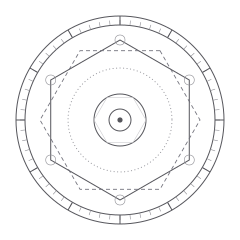
Astrological tradition assigns the following exaltations:
The Theory · The Exaltations
Planetary Exaltations: the jabbah-project proposal
Starting from the domiciles, a “jump” of 120° or 60°, clockwise and counter-clockwise — Lisa Morpurgo's proposal, and the scheme of the jabbah project.
§ The Tradition
The Traditional Exaltations
- Sun→Aries
- Moon→Taurus
- Mercury→Virgo
- Venus→Pisces
- Mars→Capricorn
- Jupiter→Cancer
- Saturn→Libra
This is plainly a very fragile scheme, in which no logic can be traced — not even the logic that Ptolemy himself assigned to the domiciles (that of the progressive distance from the Sun). For this reason we decided to follow instead the logic described by the Italian astrologer Lisa Morpurgo in her book Introduzione all'astrologia.
§ The Source
Lisa Morpurgo's Contribution
“Since the criterion of progressive distance from the Sun evidently no longer offered a secure path, we followed a new criterion of distance — namely, the distance from a planet's domicile to its exaltation. […]
“It was our view that, in order to arrive at an organic and coherent scheme of the exaltations, only a single planetary domicile could be taken as the base linked to the exaltation. And it seemed logical to choose, of the two, the domicile that formed with the exaltation a clearly positive aspect — that is, a sextile (60°) or a trine (120°). The two luminaries offered a confirmation of this hypothesis, since there was a distance of 120 degrees between the Sun's domicile and exaltation, and of 60 degrees between the Moon's domicile and exaltation.”
§ The Rule
A Trine for the Luminaries, a Sextile for the Rest
In essence, Lisa Morpurgo proposed starting from the secondary domicile of a planet (which she actually called its base domicile) to establish that planet's exaltation, using the positive distance of 60 degrees (a sextile) for Mercury, Venus, Mars, Jupiter, Neptune, Pluto, Haumea and Eris, and the distance of 120 degrees (a trine) for the Sun, Moon, Saturn and Uranus — that is, the luminaries and counter-luminaries.
In this light, the only valid exaltations of tradition turn out to be the Sun (in Aries), Mars (in Capricorn) and Saturn (in Libra) — three out of seven: few, perhaps, but important. Tradition itself has left us a meaningful trace to work from.
For our part, we add that the clockwise and counter-clockwise direction of the Zodiac gives a further indication, one that lets us establish a second exaltation, which we have decided to call precisely the secondary exaltation — just as with the primary and secondary domiciles.
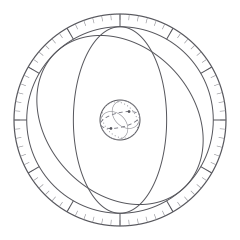
§ The Scheme · I
The Primary Exaltations
Here is the scheme of exaltations proposed by Lisa Morpurgo, which in our proposal become the primary exaltations (recall that Morpurgo spoke of “planet X” and “planet Y” for the trans-Plutonians — for us, Haumea and Eris respectively).
1 · Luminaries — Sun & Moon 120° trine from the primary domicile, clockwise
- Sun→primary domicile in Leo→120° clockwise→primary exaltation in Aries
- Moon→primary domicile in Cancer→120° clockwise→primary exaltation in Pisces
2 · Counter-luminaries — Saturn & Uranus 120° trine from the secondary domicile, clockwise
- Saturn→secondary domicile in Aquarius→120° clockwise→primary exaltation in Libra
- Uranus→secondary domicile in Capricorn→120° clockwise→primary exaltation in Virgo
3 · The other planets 60° sextile from the secondary domicile, counter-clockwise
- Mercury→secondary domicile in Virgo→60° counter-clockwise→exaltation in Scorpio
- Venus→secondary domicile in Taurus→60° counter-clockwise→exaltation in Cancer
- Mars→secondary domicile in Scorpio→60° counter-clockwise→exaltation in Capricorn
- Jupiter→secondary domicile in Pisces→60° counter-clockwise→exaltation in Taurus
- Neptune→secondary domicile in Sagittarius→60° counter-clockwise→exaltation in Aquarius
- Pluto→secondary domicile in Aries→60° counter-clockwise→exaltation in Gemini
- Haumea→secondary domicile in Libra→60° counter-clockwise→exaltation in Sagittarius
- Eris→secondary domicile in Gemini→60° counter-clockwise→exaltation in Leo
§ The Step Beyond
The Two Directions: Clockwise and Counter-clockwise
It is clear — also from the scheme of the domiciles — that the Zodiac takes both directions of the circle into account: the clockwise and the counter-clockwise. For this reason we have decided to take a step beyond Lisa Morpurgo's proposal and introduce the secondary exaltations.
§ The Scheme · II
The Secondary Exaltations
1 · Luminaries — Sun & Moon 120° trine from the secondary domicile, counter-clockwise
- Sun→secondary domicile in Cancer→120° counter-clockwise→secondary exaltation in Scorpio
- Moon→secondary domicile in Leo→120° counter-clockwise→secondary exaltation in Sagittarius
2 · Counter-luminaries — Saturn & Uranus 120° trine from the primary domicile, counter-clockwise
- Saturn→primary domicile in Capricorn→120° counter-clockwise→secondary exaltation in Taurus
- Uranus→primary domicile in Aquarius→120° counter-clockwise→secondary exaltation in Gemini
3 · The other planets 60° sextile from the secondary domicile, clockwise
- Mercury→secondary domicile in Virgo→60° clockwise→exaltation in Cancer
- Venus→secondary domicile in Taurus→60° clockwise→exaltation in Pisces
- Mars→secondary domicile in Scorpio→60° clockwise→exaltation in Virgo
- Jupiter→secondary domicile in Pisces→60° clockwise→exaltation in Capricorn
- Neptune→secondary domicile in Sagittarius→60° clockwise→exaltation in Libra
- Pluto→secondary domicile in Aries→60° clockwise→exaltation in Aquarius
- Haumea→secondary domicile in Libra→60° clockwise→exaltation in Leo
- Eris→secondary domicile in Gemini→60° clockwise→exaltation in Aries
An animation
From Domicile to Exaltation
Each of the twelve bodies leaves one of its domiciles and travels — along a straight line — to the sign of its exaltation: a 120° trine for the luminaries and counter-luminaries, a 60° sextile for the others. Each jump fades as the next begins; at the end, the wheel holds all twenty-four exaltations at once.
§ The Whole Picture
The Complete Scheme of Domiciles and Exaltations
| Sign | Primary domicile | Secondary domicile | Primary exaltation | Secondary exaltation |
|---|---|---|---|---|
| Aries | Mars | Pluto | Sun | Eris |
| Taurus | Haumea | Venus | Jupiter | Saturn |
| Gemini | Mercury | Eris | Pluto | Uranus |
| Cancer | Moon | Sun | Venus | Mercury |
| Leo | Sun | Moon | Eris | Haumea |
| Virgo | Eris | Mercury | Uranus | Mars |
| Libra | Venus | Haumea | Saturn | Neptune |
| Scorpio | Pluto | Mars | Mercury | Sun |
| Sagittarius | Jupiter | Neptune | Haumea | Moon |
| Capricorn | Saturn | Uranus | Mars | Jupiter |
| Aquarius | Uranus | Saturn | Neptune | Pluto |
| Pisces | Neptune | Jupiter | Moon | Venus |
§ The Source
Ptolemy: Of Exaltations
For the record, the chapter of the Tetrabiblos in which Ptolemy explains the traditional exaltations — the scheme our proposal sets out to correct. The translation is that of Frank Egleston Robbins (Loeb Classical Library, 1940).
Of Exaltations
The so-called exaltations of the planets have the following explanation. Since the sun, when he is in Aries, is making his transition to the northern and higher semicircle, and in Libra is passing into the southern and lower one, they have fittingly assigned Aries to him as his exaltation, since there the length of the day and the heating power of his nature begin to increase, and Libra as his depression for the opposite reasons.
Continue reading
Saturn again, in order to have a position opposite to the sun, as also in the matter of their houses, took, contrariwise, Libra as his exaltation and Aries as his depression. For where heat increases there cold diminishes, and where the former diminishes cold on the contrary increases.
And since the moon, coming to conjunction in the exaltation of the sun, in Aries, shows her first phase and begins to increase her light and, as it were, her height, in the first sign of her own triangle, Taurus, this was called her exaltation, and the diametrically opposite sign, Scorpio, her depression.
Then Jupiter, which produces the fecund north winds, reaches farthest north in Cancer and brings his own power to fullness; they therefore made this sign his exaltation and Capricorn his depression.
Mars, which by nature is fiery and becomes all the more so in Capricorn because in it he is farthest south, naturally received Capricorn as his exaltation, in contrast to Jupiter, and Cancer as his depression.
Venus, however, as she is moist by nature and increases her own proper power all the more in Pisces, where the beginning of the moist spring is indicated, has her exaltation in Pisces and her depression in Virgo.
Mercury, on the contrary, since he is drier, by contrast naturally is exalted, as it were, in Virgo, in which the dry autumn is signified, and is depressed in Pisces.