The Kuiper Belt contains thousands of trans-Neptunian objects, yet only five have been officially recognised by the International Astronomical Union as dwarf planets: Pluto, Eris, Haumea, Makemake and Ceres (the last of these in the main Asteroid Belt). Among them, jabbah-project's choice falls on Haumea and Eris, for precise reasons concerning their mass, physical structure and orbital dynamics.
The Selection of the Trans-Neptunian Planets
Why Haumea and Eris
The Kuiper Belt holds thousands of trans-Neptunian objects, yet only five are officially recognised as dwarf planets. Here is why jabbah project's sequence integrates Haumea and Eris — and not Makemake or Chiron.
§ 01
Five Dwarf Planets, Two Choices
Eris: the necessary endpoint of the scale
Eris is the most massive body in the entire trans-Neptunian region. With a diameter of about 2,326 km it is almost identical to Pluto in size, but clearly surpasses it in mass — by around 27% more. This is not a marginal detail. It was precisely the discovery of Eris in 2005 that triggered the redefinition of the concept of planet in 2006, and the demotion of Pluto. In purely astronomical terms, Eris is the object that rewrote the boundaries of the Solar System.
Its high density, around 2.4 g/cm³, points to a predominantly rocky composition covered by a layer of methane ice. Some internal-heating models based on radioactive decay further suggest that Eris could sustain an internal ocean of liquid water at the boundary between mantle and core: this is a modelling hypothesis, not an observational certainty, but it adds a possible internal structural complexity to its extremes of mass and distance. Its orbit is extremely eccentric and inclined by as much as 44° to the ecliptic, carrying it to an average distance from the Sun of about 68 astronomical units, out to an aphelion of nearly 97 AU. It is, in effect, one of the most distant and dynamically "extreme" bodies we know. For a zodiacal sequence meant to represent the outer limits of the Solar System, Eris is the strongest candidate: the most massive, among the most distant, and historically the one that forced the revision of planetary categories.
Haumea: physical uniqueness as criterion
Haumea is perhaps the most singular object in the entire Solar System for its physical properties. It is not spherical: it rotates on its axis in just 3.9 hours, the fastest rotation of any known body larger than a hundred kilometres. This speed deforms it into an elongated ellipsoid, with axes ranging from about 2,100 km to about 1,100 km.
Its density, around 2.6–3.3 g/cm³, is notably high for a Kuiper Belt object, a sign of a rocky composition with a surface of particularly bright crystalline water ice. Haumea also has two moons and, exceptionally, a ring system: it was the first trans-Neptunian object in which one was confirmed to exist (rings are now also known around the trans-Neptunian object Quaoar and the centaurs Chariklo and Chiron, but Haumea remains the pioneer among TNOs). It is also the progenitor of the only known collisional family in the Kuiper Belt, a group of objects originating from an ancient impact. Haumea remains the subject of active observation campaigns through stellar occultations, precisely because its anomalous three-dimensional shape continues to be a prized measurement target — further confirmation that its physical singularity is not a settled, once-and-for-all fact, but a peculiarity the astronomical community is still actively investigating.
No other trans-Neptunian dwarf planet presents this concentration of anomalous features: extreme rotation, ellipsoidal shape, rings, its own collisional family. From an astronomical point of view, Haumea is literally a one-of-a-kind object.
Why not Makemake
Makemake is a legitimate dwarf planet, but in terms of physical profile it is the most "ordinary" of the three. It has a diameter of about 1,430 km, smaller than both Eris and Haumea. Its estimated density is lower, around 1.7–2.1 g/cm³, suggesting a structure richer in ice and less dense. It has only one small known moon, no rings, no collisional family, an unremarkable rotation (about 22.5 hours) and an orbit less extreme than that of Eris. While an important body, it offers neither Eris's primacy of size nor Haumea's structural exceptionality. It is, in essence, an object representative of the population's average, not an extreme point of reference.
§ 02
The Logic of the Choice
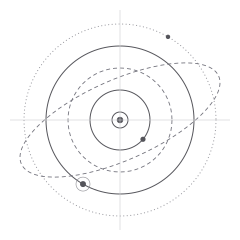
The zodiacal sequence, in jabbah-project's view, is completed by two bodies that embody the two axes along which the Kuiper Belt expresses its extremes. Eris represents the extreme of mass and distance: the heaviest body, among the most remote, the one that literally redefined the boundaries of the Solar System. Haumea represents the extreme of physical singularity: shape, rotation, rings and collisional dynamics that have no equal. Together they mark out the space of what, beyond Pluto, is truly remarkable.
On an astrological-interpretive level, this selection has an internal coherence: rather than adding arbitrarily chosen bodies, the sequence integrates the two objects that, by measurable data, mark the physical and dynamic boundaries of the known Solar System. The choice is not quantitative but qualitative: not "the biggest" in absolute terms, but those that best represent the idea of threshold, of limit, and of exception.
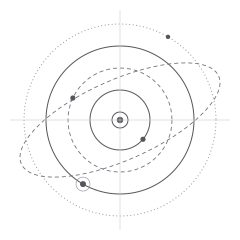
Finally, a consideration tied to the parallel and opposite planets in jabbah-project's scheme: Haumea's opposite is Pluto and its parallel is Venus; Eris is opposite Neptune and parallel to Mercury. Now, within the "twelve planets" scheme, one can see that it is above all the parallel planets that have comparable masses: giant Jupiter is parallel to Neptune (both "gas giants"), Mars is parallel to Pluto (both rocky and only slightly smaller than Earth), Saturn is parallel to Uranus (also both "gas giants"), and so on. We can say that Haumea and Eris fall within this "rule" as well (said, so to speak, in a great many scare quotes).
“
From the consenting of those I have just mentioned, thoughts appeared in the aeons that exist. From thoughts, reflectings; from reflectings, considerings; from considerings, rationalities, from rationalities, wills, from wills, words.
Then the twelve powers, whom I have just discussed, consented with each other. <Six> males (and) females (each) were revealed, so that there are seventy-two powers. Each one of the seventy-two revealed five spiritual (powers), which (together) are the three hundred and sixty powers. The union of them all is the will.
— Eugnostos the Blessed · gnosis.org
§ 03
A Note on the Names: Just a Divertissement
A brief digression on the names these bodies carry is worthwhile, but with an indispensable premise. This is extremely slippery ground, on which many have exercised themselves and many more will, and it must be taken for what it is: only an intellectual divertissement, nothing more. jabbah-project's selection rests on the astronomical data set out above — mass, distance, shape, density, orbital dynamics — not on the names. That naming conventions produce suggestive resonances is a happy coincidence, not an argument. That said, the coincidence exists, and it is curious.
The name Eris, in Greek convention, refers to a figure associated with discord and conflict. It is hard not to notice how this fits the body's actual historical role: it was precisely its discovery that generated the scientific "discord" which led to redefining the concept of planet and demoting Pluto. But note well: here the suggestion works after the fact, because the name was chosen afterward, precisely because of that controversy. There is nothing predictive about it, only a play of mirrors between event and naming.
The name Haumea, by contrast, belongs to the Hawaiian tradition and is associated with a figure linked to generation and fertility. The choice was not astronomically arbitrary: the body's two moons bear names connected to the same tradition, and Haumea's entire "collisional family" — those fragments originating from an ancient impact — lends itself to the image of a scattered progeny. Even here, though, the link between name and physical characteristics is a narrative construction built by the discoverers, not an intrinsic property of the object.
Were one to push the game as far as the Haumea–Pluto polarity discussed further on, one might observe that a name tied to generation and one tied to the dominion of the underground and the invisible make for an elegant opposition. Even more, we may recall that the Italian astrologer Lisa Morpurgo hypothesised a "Planet X", right after Pluto, as a "Great Feminine Principle", opposite to the "Great Masculine Principle" represented by Pluto. But let us repeat, because it is the point that matters: it is, precisely, a game. The soundness of the selection lies in the numbers, not in the labels. A critical reader has every right to ignore this parenthesis without the main argument suffering in the least.
§ 04
The Shape of Haumea and the Polarity with Pluto
Haumea's shape deserves one last consideration. Its extremely fast rotation, completing a full turn in under four hours, deforms the body into an elongated ellipsoid — what astronomers call a Jacobi ellipsoid. Visually, this geometry is often compared to a rugby ball or a slightly flattened egg. It should be made clear that this is an analogy of shape: the elongation arises from the centrifugal force of the rotation, not from a shelled internal structure. It remains an objective fact, however, that Haumea is the only dwarf planet not to be spherical, and that its outline spontaneously evokes this image.
On this basis, jabbah-project proposes a symbolic key of interpretation — it is important to stress that this is an interpretation specific to the project, not an established fact of astrological tradition, which on these recently discovered bodies is still taking shape. Haumea's "ovoid" form suggests a generative nature, comparable to a feminine principle, placed in mirrored opposition to Pluto.
This polarity, far from being purely decorative, finds confirmation in measurable physical contrasts. Pluto rotates slowly, in about six and a half days, and is substantially spherical; Haumea rotates in under four hours and deforms. Pluto's surface is dominated by nitrogen and methane ices, dark and reddened in some regions; Haumea's is covered in crystalline water ice, particularly bright and reflective. These are two bodies which, while belonging to the same outer region of the Solar System, express almost opposite characteristics: slowness and speed, sphere and ellipsoid, dark surface and luminous surface. The interpretive axis that jabbah-project builds between the two is thus founded not on an arbitrary attribution, but on a contrast that the astronomical data render tangible.
§ 05
Why Not Chiron
The main reason is that Chiron does not belong to the Kuiper Belt. It is a centaur — a body that orbits in the intermediate region between Jupiter and Neptune, roughly 8 to 19 astronomical units from the Sun. The Kuiper Belt begins beyond Neptune's orbit, around 30 AU. Already on this level Chiron is out of scope: if jabbah-project's criterion is to complete the sequence with trans-Neptunian objects marking the outer boundaries of the Solar System, Chiron remains structurally inside, in a completely different orbital zone. Including it would mean contradicting the very principle of the selection.
There is then a question of scale that places it on an entirely different order of magnitude. Chiron has an estimated diameter of around 210 km. To give a sense of the gap: Eris and Haumea exceed 2,000 km — ten times as much in diameter, and hundreds of times as much in volume and mass. Chiron is not remotely a dwarf planet. It does not possess sufficient mass for its own gravity to make it spherical, which is precisely the physical requirement the International Astronomical Union uses to define a dwarf planet. While Eris, Haumea, Makemake and Pluto all fall within this official category, Chiron has never been classified as one and could not be. It is a small, irregular body, comparable in size to a medium-sized asteroid.
Its physical nature is, moreover, unstable and ambiguous. Chiron shows cometary activity: it displays a coma and brightness variations typical of comets, to the point of holding a double designation, both as an asteroid (2060 Chiron) and as a comet (95P/Chiron). Centaurs like it have chaotic, dynamically transient orbits, perturbed by the giant planets, and on astronomical timescales are destined either to be ejected from the Solar System or to plunge inward, turning into comets. In other words, Chiron is not a "stable" body marking a boundary of the Solar System: it is a transient object, probably of Kuiper-Belt origin but now captured in an unstable zone. It does not represent a threshold; it represents a temporary transition.
The internal coherence of the selection is therefore clear-cut. The criteria that led to Eris and Haumea — membership in the trans-Neptunian region, dwarf-planet status, notable mass or physical singularity, an outer-boundary role — exclude Chiron on every single parameter: inner orbital position, the dimensions of a small body, lack of dwarf-planet status, cometary nature, and transient orbit. Adding it would mean abandoning the physical principle of the sequence in favour of a criterion of pure astrological popularity — something the project has explicitly chosen not to do.
An honesty caveat
The same reasoning that excludes Chiron because it is "too small and not a dwarf planet" would also apply to many objects that astrologers use. It is a strong argument precisely because it is consistent, but it is worth being aware of it, so as not to appear contradictory should the project elsewhere make use of minor bodies.
One last clarification, which matters to us. Nothing said here is meant to assert that jabbah-project's choice is "better" than that of anyone who has decided to adopt Chiron within their own zodiacal scheme. Toward that work goes our utmost respect. The reasons set out here explain only why this project, given its own selection criteria, does not include it: these are internal, declared criteria, valid for the coherence of this system, not a judgement on others. A project starting from different premises — for instance, giving weight to the symbolic role of "bridge" between the classical and the outer planets, often attributed to Chiron precisely because of its intermediate orbit — will legitimately arrive at different conclusions, and will do well to do so. The presumption of holding one's own key to be the only valid one is a mistake, and a sin of pride, which we have seen committed many times: let us try not to fall into it again.
External Sources
- Predictions of Stellar Occultations by Haumea (arXiv)
- The Dwarf Planet Eris — Universe Today
- The Dwarf Planet Haumea — Universe Today
- New Research on Formation and Evolution of Haumea — Sci.News
- Discovery of a Ring Around Haumea — CORDIS (EU)
- Crystalline Ice Covers Haumea — CORDIS (EU)