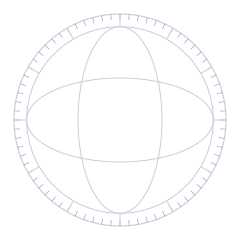
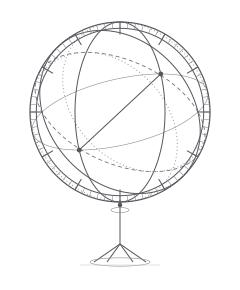
The wheel draws the rule into view, movement by movement: the two summer signs, the solar and lunar semicircles, and the planets set in order from the nearest to the Sun to the farthest — closing, at the last, with Haumea and Eris.
The Theory · The Domiciles
Planetary Domiciles: the jabbah-project proposal
From Ptolemy's rule to a zodiac of twelve bodies — how each sign comes to have its ruler, and why two planets remained to be found.
An animation
The Logic of the Domiciles
Press play on each stage, then read beside it.
§ The Scheme
The Corrected Domiciles
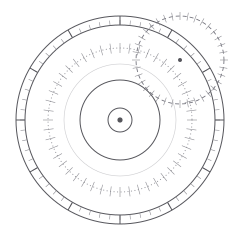
The images on this page, and their animations, set out to make visible the inner logic of the domiciles — the logic Ptolemy first described. To state it once more:
- begin from the two summer signs, Leo and Cancer;
- from Leo, moving counter-clockwise, proceed to Capricorn;
- from Cancer, moving clockwise, proceed to Aquarius;
- assign each planet's domicile by a single rule — from the nearest to the Sun to the farthest.
This is the general rule. Ptolemy applied it in the Tetrabiblos; we bring it up to date in the light of the planets discovered beyond Saturn, invisible to the eyes of the ancients. The final step: the scheme plainly calls for twelve celestial bodies, and our hypothesis is that the two missing planets are Haumea and Eris. We say it again — a hypothesis, nothing more, and we are ready to weigh any other that may be offered.
The demands of the drawing — the need to trace the path from Leo to Capricorn and from the Moon to Aquarius — leave no room to show the two levels of domicile, primary and secondary. We make good that omission here. In the table, the domiciled planet and its opposite are set in bold.
| № | Planet | Primary domicile | Secondary domicile | Opposite planet | Parallel planet |
|---|---|---|---|---|---|
| 1 | Sun | Leo | Cancer | Saturn | Moon |
| 2 | Eris | Virgo | Gemini | Neptune | Mercury |
| 3 | Haumea | Taurus | Libra | Pluto | Venus |
| 4 | Pluto | Scorpio | Aries | Haumea | Mars |
| 5 | Neptune | Pisces | Sagittarius | Eris | Jupiter |
| 6 | Uranus | Aquarius | Capricorn | Moon | Saturn |
| 7 | Saturn | Capricorn | Aquarius | Sun | Uranus |
| 8 | Jupiter | Sagittarius | Pisces | Mercury | Neptune |
| 9 | Mars | Aries | Scorpio | Venus | Pluto |
| 10 | Venus | Libra | Taurus | Mars | Haumea |
| 11 | Mercury | Gemini | Virgo | Jupiter | Eris |
| 12 | Moon | Cancer | Leo | Uranus | Sun |
§ The Pattern
The Logic of Primary and Secondary Domiciles
If one looks closely at the progression of the primary and secondary domiciles, a precise pattern emerges — an alternation of primary and secondary. Let us try to set it out as a tree diagram, leaving aside for the moment the signs of the luminaries and counter-luminaries (Cancer, Leo, Capricorn and Aquarius). Starting from Leo, counter-clockwise, the first sign is Virgo. And so, again beginning from the planet nearest to the Sun:
├── Virgo
└── Mercury (secondary)
├── Libra
└── Venus (primary)
├── Scorpio
└── Mars (secondary)
├── Sagittarius
└── Jupiter (primary)
Starting from Cancer, clockwise, the first sign is Gemini. And so, again beginning from the planet nearest to the Sun:
├── Gemini
└── Mercury (primary)
├── Taurus
└── Venus (secondary)
├── Aries
└── Mars (primary)
├── Pisces
└── Jupiter (secondary)
This scheme, however, does not work for the luminaries and counter-luminaries. One can observe, in fact, that the Sun — in primary domicile in Leo — is not opposed to Saturn (that is, to its natural opposite) in Aquarius, since in Aquarius the planet Saturn is in secondary domicile. The same holds for Cancer–Capricorn: the Moon, in primary domicile in Cancer, is not opposed to Uranus in Capricorn, since the planet Uranus in Capricorn is in secondary domicile.
Why this “anomaly”? Apparently, there is no logic to it at all. But it is likely that precisely this lack of symmetry lies at the origin of the phenomenon of the Zodiac — and, perhaps, more generally, of the phenomenon of life on Earth. Among the four Signs of the summer/winter axis (Cancer, Leo, Capricorn, Aquarius), it is as if a constant “torsion” were generated, one that then discharges its energy into all the other Signs, producing the motion that every mechanism, organic or inorganic, requires.
§ The Source
The Text of Ptolemy
We reproduce in full chapter 17 of the Tetrabiblos — the chapter from which the whole scheme descends. The translation is that of Frank Egleston Robbins (Loeb Classical Library, 1940), available online.
17. Of the Houses of the Several Planets
The planets also have familiarity with the parts of the zodiac, through what are called their houses, triangles, exaltations, terms, and the like.
Continue reading
The system of houses is of the following nature. Since of the twelve signs the most northern, which are closer than the others to our zenith and therefore most productive of heat and of warmth, are Cancer and Leo, they assigned these to the greatest and most influential heavenly bodies, that is, to the luminaries, Leo, which is masculine, to the sun, and Cancer, feminine, to the moon. In keeping with this, they designated the semicircle from Leo to Capricorn as the solar and that from Cancer to Aquarius as the lunar, so that in each of the semicircles one sign might be assigned to each of the five planets as its own house, one facing the sun and the other the moon, in accordance with the spheres of their movements and the peculiarities of their natures.
For to Saturn, in whose nature cold prevails, as opposed to heat, and which occupies the highest orbit and furthest from the luminaries, were assigned the signs opposite Cancer and Leo, namely Capricorn and Aquarius, with the additional reason that these signs are cold and wintry, and further that their aspect by opposition is contradictory to beneficence.
To Jupiter, which is moderate and below the orbit of Saturn, they assigned the two signs next to the preceding, windy and fertile, Sagittarius and Pisces, which stand in the aspect of a trine to the luminaries, which is a harmonious and beneficent configuration.
To Mars, which is dry in nature and occupies an orbit below Jupiter's, they assigned again the next signs, Scorpio and Aries, which possess a destructive and discordant nature, and, in harmony with Mars' own harsh quality, stand in the aspect of a quartile to the luminaries.
To Venus, which is temperate and below Mars, they assigned the next signs, Libra and Taurus, which are fertile and harmonious, and maintain the connection by the aspect of a sextile; another reason is that this planet is never more than two signs distant from the sun in either direction.
Finally, to Mercury, which never is more than one sign distant from the sun, they assigned the remaining signs, Gemini and Virgo, which are next to the luminaries.
§ A Closing Note
Twelve and Twelve
Lisa Morpurgo reached a similar conclusion — a domicile of the Sun in Cancer and of the Moon in Leo. But she set it within a theory of parallel universes that, in all honesty, we cannot share.
For the Jabbah Project the design is simpler, and clearer: twelve signs, twelve celestial bodies — the seven classical planets with the three trans-Saturnians, joined now by Haumea and Eris — and twelve astrological houses. Luminaries and counter-luminaries, primary and secondary: the circle closed.