
Two physical traits of Eris carry the weight of its symbolism, and both point in the same direction: toward what endures.


The Twelve Planets · № 2
Eris
The principle of duration — and the living calibration of collaboration and competition. The slowest body in the zodiac: asexual reproduction, routine, the long times.
Planet № 2 of 12Eris does not hurry. In its frozen patience the oldest law of the living is kept — that collaboration and competition are not a choice made once, but a single rhythm to be calibrated, season by season, for as long as it takes.
Primary Domicile
Virgo
Secondary Domicile
Gemini
Primary Exaltation
Leo
Secondary Exaltation
Aries
§ 01
Physical Characteristics
Diameter
~1,445 miles
Orbital period
~559 years
Moons
1 (Dysnomia)
Surface
Frozen methane
Discovered
2005
Category
Dwarf planet · TNO
1. The slowest, most distant of the large bodies
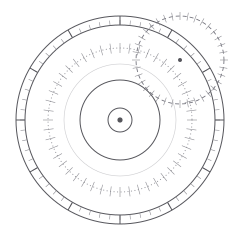
Eris takes some five and a half centuries to circle the Sun — the longest journey of any planet in the jabbah-project scheme. It is the emblem of the long times: of everything that lasts, that holds steady, that recurs without effort or even without will. From this slowness comes Eris's deepest theme — duration, constancy, the resistance of what is established to whatever would change it.
2. A bright surface of frozen methane
Eris is among the most reflective bodies in the solar system: a shell of frozen methane so cold it scarcely changes. Symbolically it speaks of fixity — the still, mirror-bright crust over a body that does not stir. The subject of a strong Eris seeks the same: firm points, planned-out routines, the comfort of the repeated gesture, a deep mistrust of metamorphosis. It is no accident that Eris stands opposite Neptune, the planet of dissolution and continual change.
§ 02
Earthly Correspondences
Eris is Planet № 2 in the planetary numbering, immediately after 1-Sun. It corresponds to the longest and most ancient phase of the living Earth — and to the humblest, most tenacious forms of life.
The age of the Earth
Coming straight after the Sun, Eris answers to the Earth's vast initial age: the upheavals, the earthquakes, the volcanic eruptions — and, in time, the forming of oxygen by the first bacterial and algal life. It is fitting that Eris is twice allied to the Sun (in Leo and Aries), the primary energy that creates and overturns, and twice to Uranus (in Virgo and Gemini), the planet of abrupt and sweeping change.
Microscopic life and the microbiome
Eris most likely corresponds to the first life on Earth: single-celled organisms, then the earliest multicellular ones — bacteria, archaea, protozoa, fungi. It stands for all microscopic life, beneficial or harmful, and is closely tied to the intestinal microbiome. Well placed, it can indicate a gut that does its work without trouble.
The wind
Eris is also the wind that lets life spread across the Earth: it moves the seas, scatters the seeds of plants, carries microscopic organisms to colonise every environment. Well placed, it can give an easy relationship with the wind — and, with a strong Neptune (the sea), a gift for sailing. Badly aspected and in a house of exile or fall, the wind may appear instead as calamity: the tornado, the accident. Linking wind, oxygen and airborne fungi, one may even read here the rising of bread and of all that depends on fermentation.
§ 03
The Collaboration–Competition Axis
A working hypothesis
Eris has no traditional astrological literature: discovered only in 2005, it has never before been read as a planet of the Zodiac. What follows — and this axis above all — is offered as a structural hypothesis to be tested, not as settled doctrine.
Eris answers to the dawn of life on Earth — single cells, the microbiome, asexual reproduction. At that original level, collaboration and competition never exclude one another. The intestinal microbiome is the perfect image: billions of organisms competing for the same resources and, at the same time, collaborating symbiotically to keep the whole system alive.
It is not a matter of choosing one mode once and for all. It is a matter of continually calibrating the balance between the two, according to circumstance — and this calibration asks for long time (Eris's signature) and procedural intelligence, never impulse. The real question the axis poses is not “collaboration, yes or no?” but: can the subject move from one mode to the other flexibly, in good time, and with awareness?
The seasonality: when to collaborate, when to compete
Eris's four signs of domicile and exaltation cover a long arc of the seasonal cycle, and mark, symbolically, the natural moment in which each mode prevails — from the spring assertion of self to the ordered collaboration of the harvest.
- Aries (secondary exaltation) · early spring — competition as the first act of survival. The individual must exist before all else: assert itself, take the risk, be present. Not destruction — the courage to be there.
- Gemini (secondary domicile) · late spring — collaboration through the exchange of information. The wind scatters the seed; life branches and communicates; light but many bonds are formed. Procedural intelligence, oriented to safety and duration.
- Leo (primary exaltation) · high summer — generous collaboration. The king protects his court by sharing his vital energy; one competes for prestige, not to destroy — “I am the best because I am the most generous.”
- Virgo (primary domicile) · late summer, the harvest — ordered collaboration. What the collaborative season produced must now be distributed by shared rules: order, hierarchy, codified procedure. Competition here is of method and merit, not aggression.
The arc is not static: competition is the starting point (Aries), mature collaboration the destination (Virgo). The individual chart shows where along this path the subject is chiefly oriented.
The three planets that govern the calibration
Neptune — the dialectical tension. Opposite to Eris, Neptune is metamorphosis, the dissolving of boundaries, continual change; Eris answers with fixity, duration, procedure. With Eris strong and Neptune weak, the subject stays rigidly locked in a single mode; with Neptune strong and Eris weak, it shifts fluidly but without coherence, and can seem unreliable. In balance, the tension turns creative: knowing when to hold the position and when to transform the relationship.
Mercury — the tool of calibration. Eris's parallel planet lends tactical finesse: where Eris gives duration and resistance, Mercury gives the reading of the social signal, the art of negotiation. Eris without Mercury tends to rigidity; Mercury without Eris to superficiality. Their natural alliance (they meet in Virgo and Gemini) yields the most useful intelligence of all — knowing what to do, and doing it durably and strategically.
Uranus — the ally for necessary change. Present with Eris in Virgo and Gemini, Uranus secures the capacity to break off collaborations that have outlived their use, and to change register sharply when the moment demands it.
“So, after all, there was not one kind of Strife alone, but all over the earth there are two. As for the one, a man would praise her when he came to understand her; but the other is blameworthy: and they are wholly different in nature. … This Strife is wholesome for men.”
§ 04
Symbolism
All that endures in a life
Eris stands for everything that has duration — what presents itself as constant, even without personal effort. Well placed in the Second House it can give a life free of money troubles; in the Sixth, work that lasts a lifetime without upheaval. Badly aspected, it gives instead a need for solidity that is never satisfied, or a duration that becomes a source of frustration. As the slowest body in the zodiac, it is the planet of the long times.
Work, bureaucracy, the methodical character
Eris, read together with the Second Planet, is especially telling for the subject's field of work. It governs the working category most hostile to change of any kind: bureaucracy — routine, standard protocol, settled procedure. Beyond any judgement of value, no political-administrative system could survive perpetual change; routine, too, plays its part in the larger balance.
Opposite Neptune, Eris neither loves nor trusts metamorphosis. It does not lose itself in dreams; it needs fixed points, is a creature of habit, plans everything well in advance. With a good Uranus it can meet change pragmatically; without one, constant change unsettles it, and in the hardest cases there is sheer immobility.
Asexual reproduction
Coming straight after the Sun — birth, life — Eris indicates the necessity of reproduction itself, the imperative that the living generate the living (its primary exaltation falls in the Fifth House, the house of reproduction). Standing before the planets of sexuality (Haumea and Pluto), Eris stands for asexual reproduction — for millions of years, at the origin of life, the only mode there was. A weak, afflicted Eris can point to difficulty in reproducing, or to modern reproduction without sexual relation; with a strong Eleventh House, childlessness may even be chosen.
§ 05
Eris in the Houses
Because Eris is the slowest planet, its position in a sign concerns everyone born across some 120 years and carries little individual weight. What matters in the birth chart is its house, its aspects with the other planets, and the reading of the Second Planet after the Ascendant.
- House I · secondary exaltation Stability, duration and routine take on great importance in the life. Badly aspected, frustration: the subject may long for continuity and fail to achieve it — or feel caged in a continuity never chosen.
- House II The accent falls on material goods, money, property. With good aspects, continuity and security; with bad ones, a sense of frustration. Relationships of competition or collaboration with the family clan.
- House III · secondary domicile Lasting bonds with siblings, and with friendships formed in adolescence. Collaboration — or competition — with brothers and sisters.
- House IV Ties to the birth family can be especially durable; the family home is lived as reassuring routine. May bring a renunciation of career (House X) for fear of leaving the safety of home.
- House V · primary exaltation The house of reproduction. Afflicted, it can mean a renouncing of procreation — borne hard if the Eleventh is empty, more lightly if it is strong. Vitality that finds its fulfilment in routine, in the repetition of the same gestures.
- House VI · primary domicile The accent shifts firmly to work. Well placed: long-lasting employment whose routine feels reassuring; good general health, a sound microbiome, resistance to infection. Badly aspected: fierce competition and poor collaboration at work; health a persistent problem.
- House VII · secondary fall The emphasis is on institutionalised bonds — marriage, professional ties. Duration becomes crucial; sudden ruptures are hard to accept serenely. With Saturn afflicted, long disputes with bureaucracy and the apparatus of the State.
- House VIII Eris is ill at ease in a house of change, detachment, risk, the unknown. May appear in the charts of politicians or financiers with very long careers, of those who founded enduring works. Good aspects: handling change effectively; possibly an inheritance enjoyed from a young age.
- House IX · secondary exile Travel and far horizons are not in Eris's nature, which needs calm, routine, repetition. With good aspects, an efficient organiser of others' journeys — all meticulously planned, where even the surprises are foreseen. A character of routine in every Ninth-House pursuit.
- House X No hurry toward independence or success. Eris works on the long times, planning every stage with great care, alternating competition and collaboration as needed — giving rise to long, well-organised careers.
- House XI · primary fall In fall, yet the Eleventh's search for balance suits Eris: it can use the house's gifts to organise long-term projects and plan necessary change — given good aspects. Badly aspected: a certain velleity in its plans; friends who suddenly turn into competitors.
- House XII · primary exile Here Eris has nothing to hold to: the exile is near absolute, and only excellent aspects redeem it. At best, a fine position for those who care for others' bodies — doctors, nurses, therapists — or a concrete patience toward the contested and the unproven. Badly aspected, watch the Sixth House before any conclusion about health.
§ 06
Aspects with Other Planets
Eris's allies are the Sun, Mars and Uranus — met in shared signs of domicile or exaltation. With the Moon, Venus and Jupiter there is no common ground; with Saturn, a kinship of duration. From Saturn outward, aspects last years or decades, and are read above all through the houses they fall in.
Eris – Sun
Natural allies (in Leo and Aries). Harmonious: a self that feels Time as its ally, sure of leaving its mark — children, heirs, works; it acts because it cannot do otherwise, and takes pleasure in it. Tense: Sun in Cancer or Capricorn (square) — frustrating conflict at home or in career; in Libra (opposition) — failures in marriage or contracts. Yet the alliance never wholly fails.
Eris – Moon
Little in common — the Moon is Neptune's ally. Harmonious: motherhood that extends beyond the usual times; a practical, protective maternal figure of good sense. Tense: the mother seen as a force of immobility, an obstacle to change and to the subject's autonomy.
Eris – Venus
Estrangement — no shared sign. Harmonious: durable affection, lasting even across great distance (Aries–Sagittarius); the microbiome a support to Venusian health. Tense: the Aries–Libra opposition sharpens self against other; the duration of bonds a constant problem — too brief, or too long.
Eris – Mars
Allies in Aries and Virgo; both prefer the status quo. Harmonious: useful stubbornness — resistance and determination wisely placed; an intelligent choice of when to compete and when to collaborate. Tense: hard-headedness, deafness to good counsel; a suggestion of change taken almost as an offence.
Eris – Jupiter
Estrangement. Harmonious: brilliant careers within bureaucracies, or solid advantages drawn from them; lifelong economic security; optimism that helps one accept the repetitive. Tense: expansion stifled by routine; conflict with bureaucracy; a bond held to for economic reasons.
Eris – Saturn
Both signify duration — Saturn's willed, Eris's by resistance or fate. Harmonious: duration joined to perseverance — success in patrimony, profession, bureaucracy, politics, the academy. Tense: long-lasting obstacles; lawsuits with authority that drag on for life; recurrent, serious infections.
Eris – Uranus
Twice allied (Virgo, Gemini), with Mercury as third. The watchword is continuity within change. Harmonious: profit drawn from both change and the long run — an excellent placement for work. Tense: where the Sixth House is involved, the working sphere can become deeply problematic.